"Something sinister is unfolding at the bottom of the world. Will you heed the call?"
"From this moment on, you'll know the world is little more than a tiny island in an infinitely expanding sea of cosmic horror."


"Something sinister is unfolding at the bottom of the world. Will you heed the call?"
"From this moment on, you'll know the world is little more than a tiny island in an infinitely expanding sea of cosmic horror."


“Actions Have Consequences! Inverted Reality by Fran Lewis is a chilling look at bad people committing horrific deeds.”
~ Irma Fritz, author of novels and short stories
------ 🕮 -------
AUTHOR BIO:

Fran Lewis worked in the NYC Public Schools as the Reading and Writing Staff Developer for over 36 years. She has three masters degrees and a PD in Supervision and Administration. Currently, she is a member of Who’s Who of America’s Teachers and Who’s Who of America’s Executives from Cambridge.
Fran is the author of more than 14 titles including three children’s books. She has written several books on Alzheimer’s disease in order to honor her mom and help create more awareness for a cure. These include Memories are Precious: Alzheimer’s Journey; Ruth’s Story; and Sharp as a Tack and Scrambled Eggs Which Describes Your Brain? She also wrote A Daughter’s Promise about her walk through the disease with her mother. Fran is the author of the Faces Behind the Stones series, a middle school series featuring stories growing up in the Bronx with her sister, and MJ magazine. Voices from Beyond is her latest book which was preceded by Mirror Image, What If?, Population Zero, and Accusations.
CATCH UP WITH FRAN LEWIS:------ 🕮 -------
Visit the other great hosts on this tour for book reviews, interviews, guest posts, and opportunities to WIN in the giveaway! Click here to view the Tour Schedule.
------- 🕮 -------
Can't see the giveaway? Click Here!
------ 🕮 -------


In The Demonologists’
Daughters, author Culpepper offers a unique premise with multiple subplots
to deliver not only mysteries, but also horror, romance, and an exploration of
the complexities of family relationships. There’s a lot going on, and there’s a
wide cast of characters, but Culpepper dishes out bite-sized morsels for
readers to easily digest. And wow, talk about cover-love! The cover of The
Demonologists’ Daughters is so evocative and perfect for the story.
Demonologists Lucille and Denny
Hebert have three living daughters – Diana, Delilah, and Dorcas. These sisters
are particularly well-written by the author who gives each a distinct
personality to make her pop from the pages. Their frustrations and actions are
believable, and it is heartwarming to see these women come together again after
living such separate lives for the years after their sister Dinah’s death.
Additionally, some peripheral characters had enough punch that readers will
clearly love or loathe them, a mark of great writing.
On the other hand, Lucille and
Denny Hebert, the demon-slaying parents, are murky characters. There’s little
to like in them, as their self-described helping of people is questionable.
Through their words and actions, it’s clear that they are racists, they
cherry-pick the Bible to support their version of Christianity, their exorcisms
are a farce, and they capitalize on them by writing books and creating films
that embellish and flat out contradict the truth. (Side note: it is a stretch
for me to believe the motive behind why the film is being made; there are
easier ways to accomplish what’s needed.) As if those scammer qualities aren’t
endearing enough, they also choose their so-called God’s work over raising
their daughters, and instead of supporting Dinah in her time of greatest need,
the Heberts worried about their own reputations – and there was a deadly price
to pay for that choice that they didn’t truly ever own. GRRRRR. There’s some
character growth and maybe even redemption for Lucille and Denny Hebert, but it
wasn’t enough to make them likable. The Demonologists’ Daughters forced
me to ponder the meaning of forgiveness and how hard it is to offer sometimes.
Again, this illustrates Culpepper’s skillful writing because readers will have
to reflect and will have so many strong feelings about these two characters.
In addition to the required
suspension of disbelief needed for an integral part of the plot to work, one of
the aspects of The Demonologists’ Daughters that I struggled with is in
character names. Deborah Hebert (who also has several nicknames starting with
D) changed her name to Diane Chambers as a nod to the character from Cheers,
and that’s acknowledged. But there’s also a Chrissy Heinz, which sounds a
lot like Chrissie Hynde (of the Pretenders), and Chrissy also goes by
Christine, but there’s also a possibly possessed doll called Christine – not to
be confused with the Stephen King possessed car of the same name, but likely
the inspiration for the name. See my point? It’s possible that listening to the
story instead of reading it caused some of my confusion; perhaps there are
distinctive spellings that would help a reader along? Authors, take note if you
think there’s a chance you’ll create an audiobook from your work-in-progress.
About the narration: I listened
to The Demonologists’ Daughters at 1.1x, barely faster than the recorded
speed. Narrator Hayli Henderson gives a terrific performance and voices the
numerous characters so that each sounds unique. Her pacing is perfect, she
handles the Louisiana bayou accents well, and the narration truly complements
the author’s writing. There are a few odd pronunciations, but some would only
be caught by readers-of-a-certain-age, like me. Overall, the audiobook of The
Demonologists’ Daughters is fabulously narrated and I’d seek out Henderson
again.
The Demonologists’ Daughters is all about coming to terms with family, warts and all, and overcoming dysfunction to find peace and even love. But don’t dismiss this as a simple feel-good story. The Demonologists’ Daughters counters the cozies with bloody chills and thrills, twists and turns, suspense, and a sickening reveal that keeps readers turning the pages. It’s strong debut fiction making K. Scott Culpepper an author to watch.


ABOUT THE BOOK: #1 New York Times bestselling author Nicola Yoon’s daring new work of dystopian horror is a propulsive satire set in an all-Black gated community.


.png)



“Assimilate now, assimilate
once we break you, or assimilate when you die. The choice is up to you.”
In the vein of The
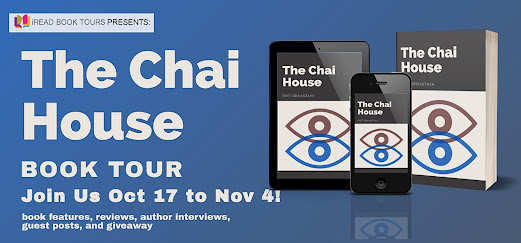
Handmaid’s Tale, in The Chai House, Priti Srivastava gives readers a
dystopian America where women are subjugated – for their own good, of
course. To protect women, the most
precious commodity, Knight and his authoritarian regime have taken over part of
a split nation and created rules that remove rights for females while giving
permission to men to be beasts. Women
can’t receive an education and have curfews. Knowledge is power, and they can’t
be out at night, you see, because it’s not safe…because of men. Oh, and if they
were out in the evenings, gallivanting about, they wouldn’t be in their homes
cooking dinner for their Knights and doing their chores. A Queen might have it
a little better with her arranged marriage and purity intact (prior to arranged
marriage, naturally), because those impure women, the worker wives (who do the
scullery), and the loaner wives (available because men need companionship when traveling,
bless their hearts), allow a Queen to have a modicum of freedom...from the men
and their rules.
While Srivastava doesn’t give
the specifics of what got the world to this point, it’s implied that the nation
split, and possibly chemical warfare ensued. There’s reference to the Mideastern
wastelands and fumes that cause hallucinations and sterility in men, making it
a perfect place to send those noncompliant men. There are also references of continuing
battles to win or win back cities and territories from Knights, who seem to be
primarily white.
“I was out of my head. Or
too into it. You know how that is.”
Our main character and
narrator, Swati, is a strong-willed and intelligent young Indian American woman
who sums up her world early on by saying she had a good life until the Fascists
came. Her relationship with her mother, Amma, is complicated, and according to
Swati, Amma “will never understand love. She only understands duty. She only
understands rules.” But as happens when children mature or are forced to grow
up early, Swati begins to understand her mother’s actions and realizes there is
more to Amma’s behaviors than meets the eye, and Amma’s warning of being
cautious of powerful white men is a piece of advice to take seriously.
“I came here for a better
life for my daughter and instead both my daughter, and my granddaughter will
have less freedom than I ever did.”
Running parallel to Swati’s
story is a second one that seems intrusive and out of place initially. Readers
get brief snippets into the nomadic life of Cindy and her young daughter, Jenny.
These characters are voiced with a syrupy Southern accent, and they seem to be
white females who are rebels trying to survive and on the run from Knight. The
author shows the tenderness between this mother and daughter, but then juxtaposes
that with the things they must do to survive. There are alarming scenes that
are powerful in their irony, as in how Cindy considers herself a good parent
and the concern of Jenny that Cindy’s kindness could get them killed.
While the two separate plots
seem incongruous, Srivastava moves each forward and eventually connects them in
a most surprising and horrific way, leaving readers with a jaw-dropping ending
that had this one exclaiming, “WAIT! WHAAAAATTTT?!”
The Chai House is a
novella-length story (127 pages) that I think could do with a developmental
edit to fill the considerable holes and gaps in the stories. Granted, in
listening to a story instead of reading one, it’s easy to miss a quick but
vital piece of information. However, there were fine details that seemed
significant in their mention but where never explained or connected anywhere
else. Srivastava provides rich descriptions of scenes and situations, but often
there’s a lack of providing the why behind them. The result is that after I
finished the book, I had quite a “but what was X about?” list in my notes.
ABOUT THE NARRATION: Deepti
Gupta is a great narration choice, and her voicing of the Indian character –
young and old, male and female -- perfectly complemented Srivastava’s text. Her
pacing is slow but even, and while her Southern accent was a bit over the top,
it left no doubt as to who was speaking in those sections. I listened at 1.25x
on Audible, which was a little faster than I’d like, but better than 1x.
(Audible really needs to align with other platforms that allow finer tuning of
speed.)
Overall, The Chai House is
an excellent debut, and I plan on reading the eBook to re-visit the story. The
author is a gifted storyteller and this world they have created clearly has
more stories to be told. I will absolutely will pick up the next book they
write.

|
| Click to see the full tour post with purchase links, author links, and schedule |


The Feast is a collection of short stories that take place on different holidays over the course of the year. The collection opens with "A New Year, a New Day, a New Life." Grant Curtis is arrested on New Year’s Day and charged with the murder of his wife Carla.In "Easter: The Resurrection," a resurrected Kyle Gardner seeks vengeance on Pastor Brian."The Vengeance of Cassidy Clay" is a narrative poem that takes place on Halloween. The poem tells the story of a slave-hunter who haunts the woods long after his death. Plus many more spine-chilling tales.